

India’s private credit investments is headed for its first US$10-billion year in 2024 as domestic funds gain traction driven by local expertise, and new AIF registrations and robust fundraising continued to grow – EY, H12024 Report Private credit provides an alternative source of financing for businesses with unique funding needs and irregular cash flows, cases which banks may avoid due to higher risk and regulatory restrictions. Private credit lending mostly takes place via asset managers involving a private credit/alternative investment (AIF) fund that intermediates between the ultimate lender and borrower. Such loans are generally senior secured, variable rate, and
[...]
Continue Reading
Enter your details to view the full report.
Private credit provides an alternative source of financing for businesses with unique funding needs and irregular cash flows, cases which banks may avoid due to higher risk and regulatory restrictions. Private credit lending mostly takes place via asset managers involving a private credit/alternative investment (AIF) fund that intermediates between the ultimate lender and borrower. Such loans are generally senior secured, variable rate, and may comprise multiple credit facilities.
The Private Credit market has been growing at a fast pace across the world, and India is no exception. Globally, the market started gaining pace after the financial crisis in 2008 as banks retreated from riskier lending to small and mid-sized businesses and to companies backed by Private Equity. It witnessed a 5x growth in assets under management (AUM) over the last 10 years to over US$2 trillion in 2023.

With respect to the market share in the private credit space, there has been a trend reversal in the last few years. Domestic private credit funds started stealing the pie from global counterparts due to several factors such as the local expertise of asset managers and other factors as outlined below helping them to achieve market depth and diversification.
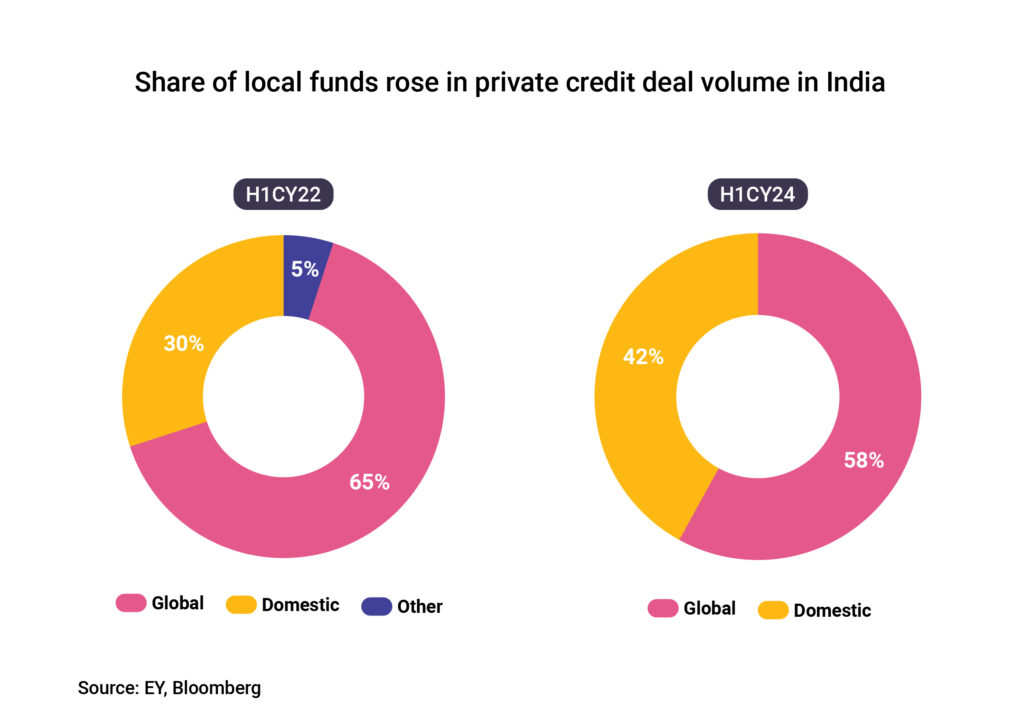
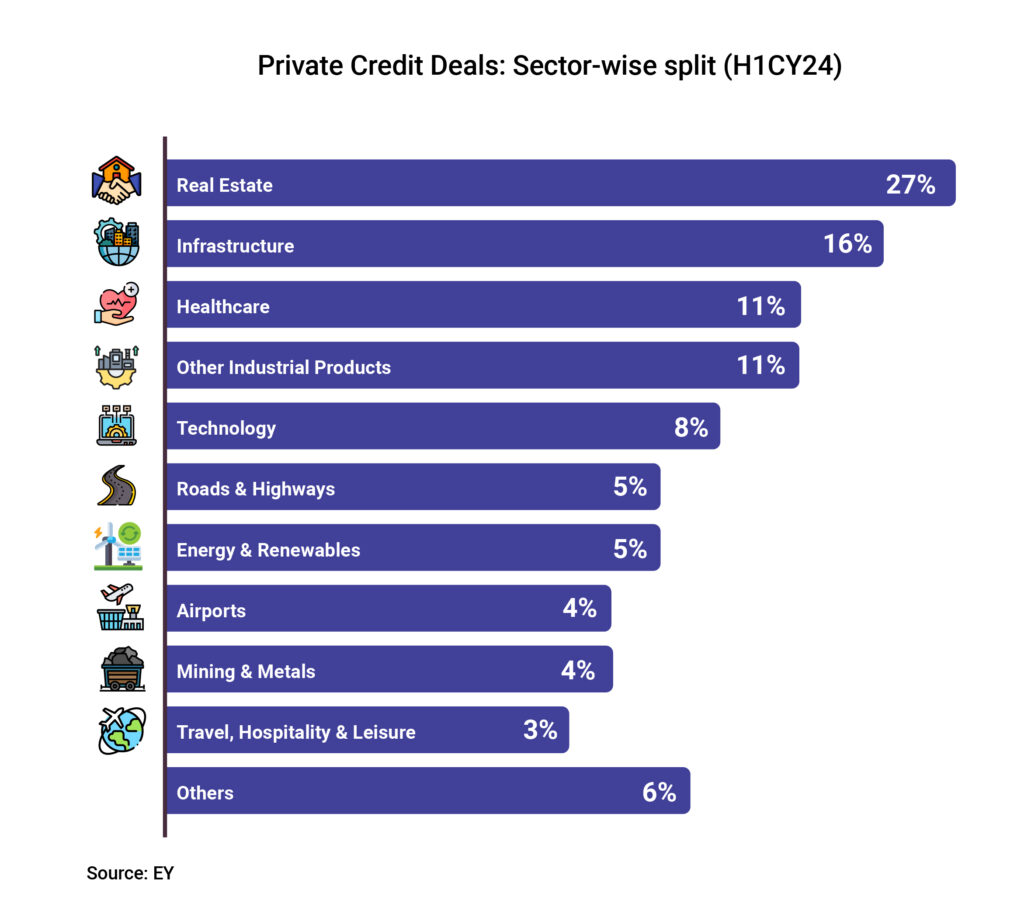
In the first half of 2024, India’s private credit market gained significant momentum as private credit investments surged to an all-time high for any six-month period. Investments totaled US$6 billion which are deployed across 96 deals. Like before, real estate dominated the space, in terms of value, followed by infrastructure, and other sectors.

- Infrastructure spending: Private credit gets an impetus from the government’s push for large infrastructure projects. The Centre has doubled the spending on infrastructure projects over the past three years with the objective of boosting the economy. In the Union Budget, a record INR 11.11 lakh crore has been earmarked for such projects in the financial year ending March 2025 (FY25), which in terms of GDP, stands at 3.4%. As large corporations win more and more infrastructure projects, ancillary work is being awarded to more and more small and mid-sized companies boosting the demand for private credit.
- Flexible financing solutions: The private credit players are able to provide flexible financing solutions to fast-growing mid-sized companies, including favorable loan structures and repayment schedules, compared to traditional bank loans, while catering to borrowers’ specific needs.
- Regulatory climate: The enactment of the Insolvency and Bankruptcy Code (IBC), 2016, acted as a catalyst for the growth of the private credit market in India. It became a statutory instrument to effectively safeguard funds’ interest in debt investments in companies that are moved to IBC proceedings and boosted investors’ confidence. This is because IBS helped in expedite insolvency resolutions and maximize returns for creditors.
- Role of digital infrastructure: India’s digital infrastructure (with the likes of the Account Aggregator framework) has been playing a key role in developing the private credit market by streamlining the underwriting process. It made easier for private credit lenders to access goods and services tax (GST) records, credit histories, and other relevant information.
- Tax reforms: Private credit funds, mainly Debt AIFs, got the much-awaited level-playing field in the taxation of debt investment products as the Finance Act 2023 brought tax parity across all debt products. It leveled the playing field for debt asset managers of various pooled investment vehicles by standardizing taxation.
- Shift in investors’ preference: Higher disposable income and better access to financial information have enabled the young Indian population to make prudent investment decisions, increasingly moving them away from traditional investment avenues to private credit funds/AIFs.
Conclusion
Several Private Credit exits in H1CY24 depicted a vibrant market with significant returns and evolving strategies. Going forward, confidence in the asset class is expected to grow with more and more high-net-worth individuals (HNIs) and family offices backing domestic funds and with a faster pace of growth in the economy.
Disclaimer:
The views provided in this blog are of the author and do not necessarily reflect the views of Vivriti. This article is intended for general information only and does not constitute any legal or other advice or suggestion. This article does not constitute an offer or an invitation to make an offer for any investment.