
Union Budget FY24
The Union Budget for FY24 was no doubt a balancing act between fiscal prudence and growth. This happens as the domestic economy has been witnessing broad-based recovery post the pandemic amid the slowdown in the global economy.
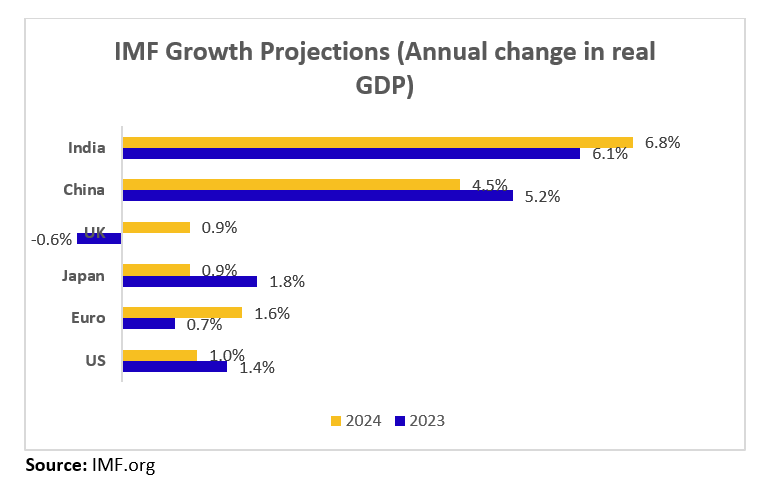
According to a recent study by IMF, global growth is expected to come down from 3.4% in 2022 to 2.9% in 2023 but it will recover to 3.1% in 2024. However, the slowdown is expected to affect most of the advanced economies compared to the emerging markets and developing economies. India is identified as the bright spot. Along with China, it is projected to account for ~50% of global growth in 2023 compared to just one-tenth for the US and Euro regions combined. Hence, to keep the resilience in domestic demand and retain the ongoing recovery, it is imperative for the govt to focus on growth.
Like in previous years, the Centre has resorted to capital expenditures to boost the economy. For FY24, it increased the capital outlay for the third year in a row by 33% to INR 10 lakh crores (which is ~3x the outlay in FY20), accounting for 3.3% of GDP. The budgetary capex is aimed at public infrastructure with roads & highways (INR 2.6 lakh crores), railways (INR 2.4 lakh crores), and defence (INR 1.7 lakh crores) being the top three sector recipients.

Fiscal prudence
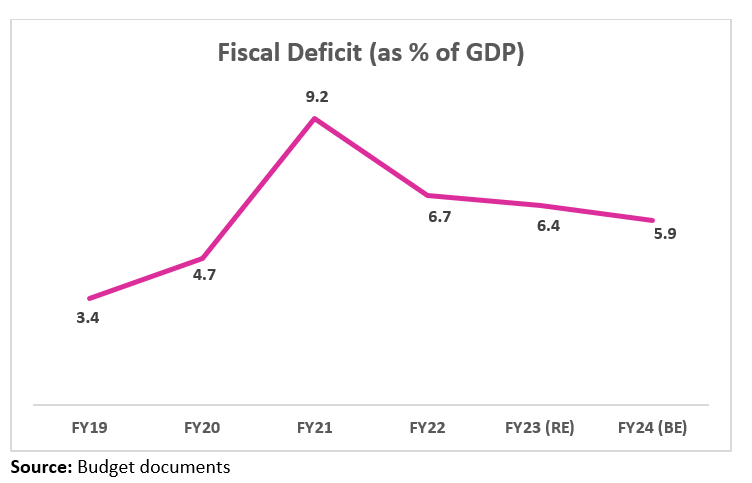
The Centre has proposed to reduce the fiscal deficit from 6.4% (RE) in FY23 to 5.9% (BE) in FY24 eventually to sub-4.5% by FY26. The need to kick in the fiscal prudence in the current budget emanated from higher deficits (9.2%) during Covid leading to a rise in debt and interest repayments. The share of interest payments as a percentage of revenue expenditure has, in fact, increased from ~27% in FY20 to ~31% in FY24 (BE).
Government borrowings
The government proposed to finance the fiscal deficit of FY24 with gross market borrowings (done mainly via issuance of bonds or g-secs and the remaining via small securities savings and other sources) of INR 15.4 lakh crores (up ~8% over FY23 (RE)). This came lower than the median of bond market expectations of ~INR 16 lakh crores.
Cues for Alterative Investment Funds (AIFs)
From the perspective of AIF industry, the government has further supported International Financial Services Centre (IFSC) in GIFT City by delegating powers from other regulators to International Financial Services Centres Authority (IFSCA) to avoid dual regulation, introducing a single window approval mechanism, and bringing necessary amendments in the existing tax regime for funds set up in IFSC. This will encourage both the launch of new funds in IFSC as well as the relocation of existing funds to it.
Also, the reduction of the highest surcharge rate from 37% to 25% would be welcomed by individual investors earning interest income through debt funds.
Outcome of RBI MPC Meeting
RBI’s Monetary Policy Committee has hiked the repo rate for the sixth time in a row in a 4:2 majority decision. The key rate at which the central bank lends short-term funds to commercial banks now increased by 25 basis points (bps) to 6.5% while the policy panel retained its focus on the withdrawal of the accommodative policy.

In this fiscal year, the cycle began with a 40 bps hike last May followed by three consecutive hikes of 50 bps and then with 35 bps in Dec 2022. RBI governor Shaktikanta Das in a previous media interaction had said that “High policy rates for a longer duration appear to be a distinct possibility, going forward”.
Inflation
RBI cut its inflation forecast marginally for FY23 from 6.7% in the December meeting to 6.5% currently. The current projection assumed normal monsoon as before and lower prices of crude oil at US$95/barrel than previously.
Inflation for FY24 is projected to be lower than FY23 at 5.3% with 5% during Q1, 5.4% during Q2, 5.4% during Q3, and 5.6% during Q4. Notably, RBI has the mandate to ensure that retail inflation remains at 4% with a margin of 2%.
However, the central bank has noted some stickiness of the core inflation due to an anticipated upward thrust on commodity prices with the easing of Covid-related restrictions and the continued pass-through of input costs to output prices, especially in services. Input cost and output price pressures are expected to soften in the manufacturing sector though.
Growth Forecast
RBI has upped the forecast of real GDP growth for FY23 from 6.8% in its December meeting to 7% currently, attributing the driving factors to private consumption and investment. The forecast for FY24 is pegged at 6.4% with 7.8% in Q1, 6.2% in Q2. 6% in Q3, and 5.8% in Q4.
Movement in Bond Yields
Disclaimer:
The views provided in this blog are the personal views of the author and do not necessarily reflect the views of Vivriti. This article is intended for general information only and does not constitute any legal or other advice or suggestion. This article does not constitute an offer or an invitation to make an offer for any investment.